
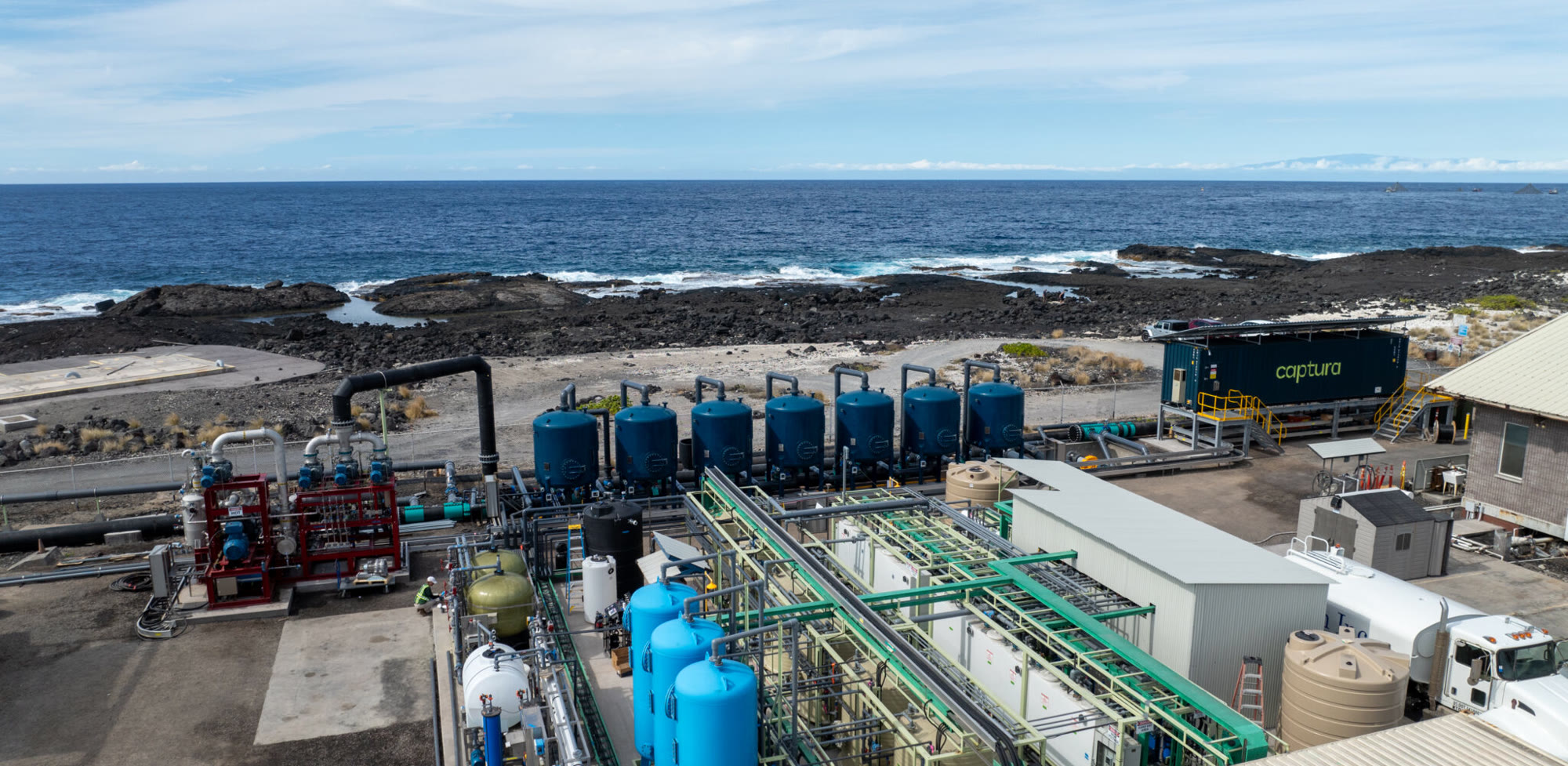
Most DOC conversations start with the technology and end with the site. In China, the order is closer to the reverse: a project becomes real when land, power, storage and permits line up in one place. The technology is necessary, but it is not the scarce input.
1. Site: the ocean has to cooperate
A DOC plant needs seawater with the right movement and chemistry, and a short, permitted intake. The parameters we screen on:
- Current speed. Fast, well-mixed water helps disperse the returned, CO₂-depleted stream. At Lingao the maximum surface current is 86 cm/s against a design threshold of 50 cm/s.
- Tidal range and waves. These drive intake design and construction cost. Lingao's mean tidal range is 1.8 m, with significant wave heights of 0.2–0.6 m.
- Bathymetry. A short intake — 50–100 m offshore, in 3–5 m of water at Lingao — is materially cheaper than a long subsea pipeline.
- Land. A 50,000 t/yr plant needs an industrial plot with room for intake, outfall, stacks and CO₂ handling. Lingao's plot is about 94 mu.
- Zoning and admission. The site must be inside a development zone that will admit the project and support its permits.
2. Power: quantity, price and flexibility
Electricity is the largest operating cost, and its price varies by province and by contract structure. Three questions matter more than the headline tariff:
- Volume. A 50,000 t/yr plant needs a substantial annual supply, contracted for the project life rather than spot purchase.
- Price structure. Time-of-use pricing, capacity charges and green certificate costs all change the effective cost per tonne.
- Flexibility. DOC can follow surplus renewable power, which is an advantage for the grid and can improve the commercial case. It requires the plant and the offtake to tolerate variable load.
At Lingao, a non-binding MOU with CHN Energy (Hainan) Integrated Energy Co., Ltd. covers long-term renewable supply. Commercial terms are confidential and are not a substitute for a signed power purchase agreement.
3. Storage: the part that cannot be improvised
Captured CO₂ has to go somewhere permanent. In China, that usually means a saline aquifer or an oilfield storage project operated by a national oil company. The practical questions:
- CO₂ stream quality. Water, oxygen and impurities affect compression and pipeline materials.
- Transport. Pipeline is cheapest at scale; trucking is possible for early volumes but expensive per tonne.
- Injection and monitoring. A storage permit, a monitoring plan and a liability framework are needed, not just a well.
- MRV. Storage must be measurable and verifiable, with a buffer for reversal risk.
At Lingao, a dedicated cooperation meeting with CNPC Southern Oilfield has been held and minutes issued; a storage MOU is in progress. We describe that as “in discussion”, not “secured”.
4. Permits: the long pole
For a coastal project of this kind, the permission set typically includes:
- park admission and site allocation;
- project filing (立项备案);
- environmental impact assessment;
- sea-use approval for intake and outfall;
- land use rights and construction permits;
- grid connection and power purchase arrangements;
- storage-related approvals with the operator and regulator.
These run in parallel, not in sequence, and each has its own data requirements. A project that has a site letter but no EIA is not close to construction; a project with an EIA but no land is not either.
5. MRV: design it before you build
Ocean-based removal is quantified with models and monitoring, not with a meter at the stack. The Isometric DOCS protocol requires a project design document, a validated ocean model, four spatial domains, a monitoring plan and a VVB. Retrofitting MRV after construction is expensive; designing it with the plant is not.
For a Chinese project, data handling matters too. Raw ocean data does not have to leave the country for the modelling to be credible, but the model outputs and the verification trail must be auditable by an accredited body.
6. Offtake: the commercial precondition
A project can be permitted and still not be financeable. Long-term offtake, at a price that covers full cost, is what turns the engineering into a project. That is why we publish cost ranges rather than a single number: buyers need to see the boundary they are pricing.
The Lingao checklist, as it stands
- Signed: Captura MOU and services agreement (2024); CHN Energy power MOU, non-binding (April 2026).
- Issued: Lingao site-intent letter (March 2026).
- Accepted: park admission (March 2026).
- In discussion: CNPC Southern Oilfield storage MOU; further Captura agreements.
- Planned: construction, commissioning, expansion.
That is the honest state of a first-of-a-kind project: real progress on site and power, work still to do on storage and permits. A checklist that shows the gaps is more useful than a timeline that hides them.
Sources
- Carbonjour project documents for the Lingao phase 1 (site letter, park admission, power MOU, storage meeting minutes).
- Isometric, Direct Ocean Capture and Storage v1.0 (October 2025).